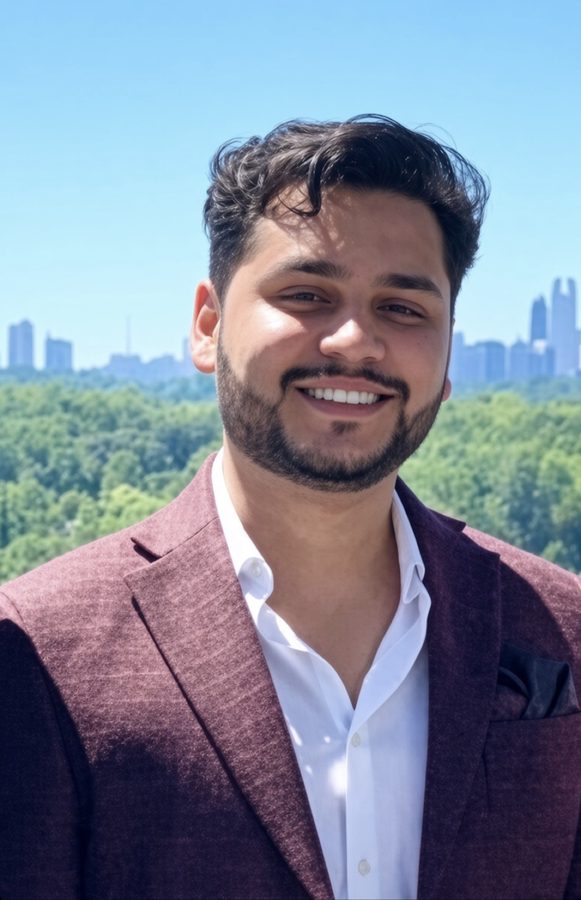
Puru Gaur
Puru Gaur is a biopharma competitive intelligence leader. He holds an MPH from Emory University's Rollins School of Public Health (#2 in the nation) and an MBA in Healthcare Management from the University of Arizona (#7 in the nation).
His public health path began at Georgia State University, where he earned a Bachelor of Science in Public Health from the School of Public Health — ranked #1 in Georgia for public health by U.S. News & World Report.
He is a Doctor of Business Administration in Health candidate at University College London — ranked #9 in the world in the QS World University Rankings 2026.
By day, Puru is a Director of Competitive Intelligence at a leading life sciences advisory firm, where he advises clients across the spectrum — from multi-billion-dollar pharmaceutical companies to smaller biotechs.
His career spans Biogen, PhRMA, AmerisourceBergen (now Cencora), EVERSANA, Vir Biotechnology. Doctor of Business Administration in Health candidate, 2026, at the Global Business School for Health, University College London.
How I Got Here, in My Own Words
Click to read
When I first arrived in the United States, my family had a one-way plane ticket from New Delhi to Cleveland, Ohio.
As you can imagine, the contrast was quite something. Not just culturally, but climatically. I remember stepping off that plane sometime in January, shortly after my sixth birthday, and seeing what appeared to be an endless blanket of white.
It was snowing.
I had never seen snow before. Growing up in New Delhi, snow was something I had only encountered in books, cartoons, and stories. I knew it existed, but seeing it with my own eyes was an entirely different experience. I remember looking around in complete amazement. I hadn't realized nature was capable of producing something so beautiful, so strange, and so different from anything I had known.
And naturally, that made me curious.
I remember standing outside the airport, waiting for my father to pull up, looking toward the sky, and sticking my tongue out to see what snow tasted like.
That was my first memory of America.
My second memory was our apartment building in Cleveland. It was enormous, at least to my six-year-old eyes, standing approximately 28 stories tall. Coming from New Delhi, where my experience of urban living had been entirely different, I was fascinated by the sheer scale of it. I remember stepping into the elevator, pressing the button for the thirteenth floor, and watching the numbers climb.
I thought to myself, Wow. This must be the greatest country on Earth.
But my third memory, perhaps my favorite of all, would fundamentally change how I understood the world.
One afternoon, my father placed a five-dollar bill in my hand and gave me my first assignment in America.
"Take the elevator downstairs. There's a grocery store on the corner. Go inside and get us some milk."
A fairly straightforward task, I thought. I was six years old, but I was confident I could manage it.
So I grabbed my jacket, which had been purchased in Delhi and which I naively assumed would be sufficient for an American winter. As it turns out, a jacket designed for New Delhi's January weather is not particularly useful against Cleveland's.
Nevertheless, I made my way downstairs, found the grocery store, and walked inside.
In my best attempt at English, I approached the woman working there.
"Ma'am, can you please help me find the milk?"
"Oh, honey," she replied, "it's in the far-right corner of the store."
I thanked her and headed toward the back.
What I encountered next absolutely blew my mind.
There wasn't just milk.
There was whole milk. Two percent. Skim milk. Almond milk. And, most astonishingly, chocolate and strawberry milk.
I was completely bewildered.
What I had assumed would be a simple exercise in purchasing milk had suddenly become an introduction to something I had never really contemplated before: choice.
Where I came from, milk was milk. You bought it, you brought it home, and that was the end of the discussion. But here, I was standing in front of an entire wall of possibilities.
And the chocolate and strawberry varieties presented an even more fascinating question.
How on Earth had Americans figured out how to make milk from chocolate and strawberries?
In my six-year-old mind, this was nothing short of a technological breakthrough. I had stumbled upon an invention that surely the rest of the world needed to know about.
Once again, I thought, This really is the greatest country on the planet.
Naturally, I picked up the chocolate and strawberry milk. I couldn't possibly return home with ordinary milk when I had just discovered something so extraordinary.
When I approached the checkout counter, I proudly announced my findings.
"Ma'am, it's fascinating that you have chocolate and strawberry milk!"
She looked at me, slightly puzzled.
"What's so fascinating about that, honey?"
"How did you figure out how to make milk out of chocolate and strawberries?"
She smiled.
"Oh, sweetie. You just add chocolate or strawberry flavor to regular milk."
I paused.
"Oh. That's it? So there aren't any black or pink cows involved in the process?"
She burst out laughing.
And then I started laughing.
We laughed together, at my misunderstanding, at the innocence of the question, and perhaps at the beautiful absurdity of a little boy discovering America one carton of flavored milk at a time.
I handed her my five dollars, collected my change, and made my way back upstairs to proudly present my findings to my parents.
We all had a good laugh.
Looking back, that may have been the last day I remember feeling entirely like a child.
Because somewhere between that first snowfall, that elevator ride, and those cartons of milk, I was beginning to understand that my life was going to be different.
My parents had left behind everything familiar to build a better future in a country they were still learning to navigate. And while I was only six, I gradually came to recognize that I had a responsibility, not just to myself, but to them.
I had to figure this country out.
How did things work here? How did the education system function? What opportunities existed? How could I help my family understand a place that was so different from the one we had left behind?
And perhaps most importantly, how could I make sure that the sacrifices my parents had made would eventually amount to something?
I grew up rather quickly.
While my friends were playing Pokémon, attending sleepovers, and enjoying the ordinary privileges of childhood, I often found myself at home, studying, doing homework, and learning about physics, biology, geology, and whatever else had captured my imagination that week.
But I don't want to give the impression that learning was simply an obligation imposed upon me.
Quite the opposite.
I genuinely loved it.
I wasn't particularly interested in asking my parents for toys or expensive gifts. I wanted to visit national parks. I wanted to become a Junior Park Ranger. I wanted to know how mountains formed, why animals behaved the way they did, how the human body worked, and why the world operated as it did.
I wanted to understand things.
And that curiosity eventually became the common thread running through my life.
A willingness to learn. To ask questions. To challenge my own assumptions. To understand not merely how something works, but why it works, who benefits from it, who gets left behind, and whether there might be a better way.
That curiosity also taught me something important about myself.
I have never claimed to be the smartest person in the room.
In fact, I hope I never start believing that I am.
Because the day I convince myself that I have nothing left to learn is the day I become content. And the day I become content is the day I lose that fire in my belly, the very thing that has pushed me forward for as long as I can remember.
What I do believe, however, is that I am persistent.
Consistent.
I'm the person you can bet on to show up, to keep trying, and to figure things out, even when the odds aren't particularly encouraging.
And I haven't always gotten it right.
During my undergraduate years, my family was dealing with the aftermath of my mother's accident. It was a difficult period, emotionally and personally, and I wasn't making the best decisions for myself.
I wasn't attending classes consistently. When I did show up, I was often exhausted. My health wasn't a priority, my academic performance suffered, and eventually my GPA fell to a 1.7.
A 1.7.
For someone who had grown up believing education was the greatest opportunity this country could offer, that number was difficult to confront.
I could have pointed to the circumstances surrounding me. And those circumstances were real. They were difficult, and they undoubtedly affected me.
But I also had to acknowledge something uncomfortable: while I couldn't control everything that had happened to my family, I could control how I responded to it.
I remember telling myself, If I don't do something about this, no one else is going to come along and do it for me.
So I picked myself up by my bootstraps.
I began showing up again. I rebuilt my habits, took ownership of my decisions, and slowly worked my way back.
I eventually graduated with a 3.4 GPA.
It wasn't a perfect academic record, but it was something I was incredibly proud of because I knew what it had taken to get there.
More importantly, it taught me that a person's trajectory is not necessarily determined by where they begin, or even by how badly they stumble along the way.
It is determined, at least in part, by what they decide to do next.
And so I began asking myself another question.
What else might be possible?
I took another leap of faith.
I applied to graduate schools that, for much of my childhood, had seemed almost mythical. Harvard. Yale. Johns Hopkins. Emory.
These were institutions I had read about, admired, and occasionally wondered whether someone with my background had any business approaching.
But I applied anyway.
I reached out to people I didn't think were reachable. I knocked on doors I wasn't sure I was supposed to knock on. I asked questions, sought advice, and refused to let my own assumptions about what was possible make the decision for me.
And Emory University took a chance on me.
That opportunity changed my life.
At the Rollins School of Public Health, I began to develop a much deeper appreciation for the systems that shape our lives, particularly healthcare.
I studied health policy and management, and I came to understand that healthcare is not simply a collection of hospitals, physicians, medicines, or insurance companies.
It is an extraordinarily complex ecosystem of people, institutions, incentives, regulations, resources, and competing priorities.
Every decision has consequences. Every policy creates trade-offs. Every dollar allocated in one direction is a dollar unavailable somewhere else.
And behind those decisions are human beings whose lives may depend on whether the system works.
I became fascinated by the history of these institutions. Why were they created? What problems were they originally intended to solve? How had they evolved? Which assumptions were still valid, and which were overdue for reconsideration?
Perhaps most importantly, how could we improve them without losing sight of the people they were meant to serve?
But the more I learned, the more I realized that public health and healthcare policy could not be understood in isolation.
Healthcare doesn't exist separately from business.
The two are deeply interconnected, often dependent on one another, and occasionally in tension.
Scientific innovation requires capital. Healthcare delivery requires infrastructure. Insurance depends on risk management. Pharmaceutical development depends on commercial incentives. And public policy ultimately influences all of them.
So I took another leap of faith.
I went to business school.
I pursued an MBA in Healthcare Management and immersed myself in economics, finance, management, operations, organizational strategy, and the commercial realities of healthcare.
I wanted to understand both sides of the equation.
How do we create medical innovations that improve human lives, and how do we build the economic and institutional structures necessary to make those innovations accessible and sustainable?
That question eventually brought me into the pharmaceutical and life sciences industry, where I began working at the intersection of science, economics, strategy, and healthcare.
From pharmaceutical forecasting and market analysis to management, operations, and strategic decision-making, my professional life became an extension of the curiosity I had carried since childhood.
I was still trying to figure out how things worked.
Only now, instead of trying to understand why there were different kinds of milk in a grocery store, I was trying to understand why some of the most extraordinary medical breakthroughs in human history remained financially inaccessible to the people who needed them.
And that brings me to where I am today.
I've taken yet another leap of faith.
I'm now pursuing a Doctor of Business Administration in Health at University College London — ranked #9 in the world in the QS World University Rankings 2026 — one of the world's leading universities.
My doctoral research focuses on a problem that I believe will become increasingly important as medicine advances: How do we finance potentially curative cell and gene therapies when their costs are concentrated upfront, but their benefits and uncertainties extend over many years?
Consider a therapy administered only once, potentially offering benefits for decades, but costing hundreds of thousands or even millions of dollars.
Who should pay for it?
How should they pay?
What happens if the therapy stops working after five years? What happens when the patient changes insurers? How do we protect the patient, ensure that manufacturers are fairly compensated for innovation, and give payers and investors sufficient confidence to participate?
And how do we distribute the financial risk in a way that makes these treatments accessible without placing an unsustainable burden on healthcare systems?
These are the questions I am trying to answer through my research into outcomes-based financing and risk-sharing mechanisms.
But there is another dimension to this work that increasingly occupies my thinking.
The very technologies capable of transforming medicine also raise profound questions about biosecurity and their potential for misuse.
Gene editing, synthetic biology, and advanced biotechnology hold extraordinary promise. We are approaching a future in which diseases once considered incurable may become treatable, and in some cases potentially curable.
But the tools that make these advances possible are not inherently limited to benevolent applications.
The same scientific capabilities that allow us to manipulate biological systems for therapeutic purposes can, under different circumstances, be misused to cause harm.
That creates an entirely different set of questions.
How do we prevent the deliberate misuse of biotechnology without stifling legitimate scientific progress?
How do we establish meaningful safeguards when scientific knowledge, commercial competition, and national security interests increasingly overlap?
And perhaps most importantly, how do we build international consensus among countries that may not trust one another, particularly when some of these technologies have both defensive and potentially offensive applications?
I worry that our ability to develop powerful technologies may be advancing faster than our ability to govern them responsibly.
That is not an argument against scientific progress. Far from it.
I am an enormous believer in science and what it can do for humanity.
But I also believe that the more powerful our tools become, the greater our responsibility to consider not just what we can do with them, but what we should do, how we protect against misuse, and who ultimately bears the consequences when things go wrong.
These questions, spanning healthcare, economics, business, public policy, and global security, may appear disconnected at first.
To me, they are all part of the same intellectual journey.
A journey that began with a six-year-old boy standing in the snow, wondering how something so extraordinary could exist.
A journey shaped by curiosity, by responsibility, by failure, by second chances, and by a persistent desire to understand the world a little better than I did the day before.
I have made mistakes along the way. Plenty of them.
I've gotten into trouble. I've taken risks that didn't work out. I've made assumptions that turned out to be completely wrong. I've been humbled more times than I can count.
And as an only child, I didn't have an older sibling to show me the ropes or warn me about every poor decision waiting around the corner.
I had to figure much of it out myself.
If you told six-year-old me not to touch the stove because it was hot, chances are I would have touched it anyway.
Not because I didn't believe you.
But because some part of me needed to understand why it was hot.
That instinct has served me well on some occasions and gotten me into considerable trouble on others.
But I wouldn't trade it.
Because every mistake has taught me something. Every setback has forced me to reconsider an assumption. And every new opportunity has reminded me that the boundaries we place around our own potential are often far narrower than the possibilities that actually exist.
I don't share my story because I believe it is particularly extraordinary.
I share it because somewhere out there is another six-year-old, another immigrant child, another first-generation student, or another person who feels as though the rooms they dream of entering were built for somebody else.
Perhaps they're struggling academically. Perhaps their family is going through something difficult. Perhaps they don't have the right connections, the perfect grades, or a clear roadmap.
Perhaps they simply don't know where to begin.
If there's anything my journey has taught me, it's that you don't have to have everything figured out before you begin.
You just have to be willing to start, to learn, to make mistakes, to take responsibility, and to keep showing up.
The rest, in my experience, has a remarkable way of revealing itself along the way.
So to all the only children out there, and perhaps to anyone else trying to navigate life without a particularly clear instruction manual:
I touched the stove so you wouldn't have to.
And trust me, it burns.
But I also know that curiosity and free will are among the greatest gifts we possess. I would never want to take either away from your imagination.
So ask questions. Take chances. Knock on doors. Challenge assumptions. Make your own discoveries.
And if you absolutely must touch the stove, at least try to learn something from it.
Thank you for taking the time to read my story.
In many ways, this is simply my small attempt to give something back to a world, and a country, that has given me so much.
And if that six-year-old boy from New Delhi could see where life has taken him today, I suspect he'd have just one question:
What else is possible?
And quite frankly, that's the question I'm still trying to answer.
Why build all this?
Competitive intelligence has a packaging problem. The insights are world-class; the delivery is a 60-slide deck that dies in an inbox. His work focuses on fixing the delivery — same rigor, served like a story you'd actually finish. Game theory underneath, plain English on top.
The operating principles
Puru works by ten principles. The first two tell you everything:
1. Give back to the next generation — "plant trees under the shade of which we do not expect to sit."
2. Transparency — every decision runs through Puru; anything AI-generated gets verified by a human, because people can lie.
The rest: humility, grace, a fail-first mindset, teamwork, always finding the honest sale, an ecosystem mindset, growing the network, and fair pay with full transparency.
Beyond the desk
Puru volunteers as a Taekwondo instructor for children in underserved areas and serves as a public-health advisor with Ladybug for Girls®. Ladybug for Girls® Sport Wellness is an American sports-based youth development program that provides girls ages 5-12 years with evidence-based health education classes and sport safety resources. His doctoral research is on financing curative therapies, beginning with the societal value of vision restoration.
At home, quality control is run by Momo (golden retriever) and Leo (German Shepherd). Meet them →
Get in touch
Résumé: View the professional résumé →
Call or text Puru directly: (404) 620-1781
WhatsApp Business: — by appointment
Or use the contact form.